
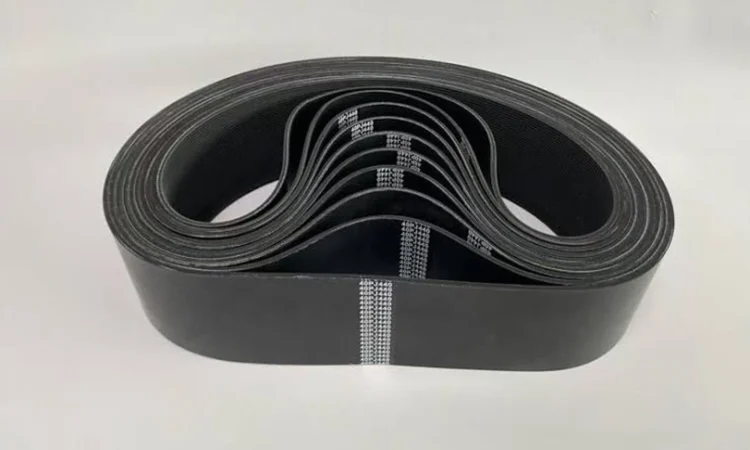
The poly V belt – also known as the ribbed belt or multi-rib belt – is among the most efficient power transmission belt designs available for compact, high-speed drive applications. Its multiple longitudinal ribs provide a larger contact area per unit of belt width than conventional V-belts, enabling higher power transmission capacity at lower belt tensions and with greater flexibility around small-diameter pulleys. Selecting the correct poly V belt for a specific application requires matching the belt’s rib profile, width, length, and material properties to the actual load and speed demands of the drive rather than substituting the nearest standard size and assuming it will perform adequately.
Understanding Poly V Belt Rib Profiles
Poly V belt manufacturers produce belts across several standardised rib profiles whose dimensions determine the size of pulley the belt can be used with, the maximum speed at which the belt can operate without centrifugal force losses becoming significant, and the load per rib that the belt can sustain without accelerated wear. The principal rib profiles are designated J, L, M, K, and H in the metric system, with J-section being the most commonly used for domestic appliance and automotive auxiliary drives and K and L sections serving larger industrial and commercial equipment applications.
Choosing the wrong rib profile for a given pulley groove creates belt-to-groove fit problems that cause uneven load distribution across the ribs, increased heat generation at the belt-pulley interface, and accelerated ribwear. A poly V belt specified to match the pulley groove profile manufactured to DIN or ISO standard – rather than adapted to a non-matching pulley – is the starting point for any correct specification.
Load Calculation and Belt Width Selection
The power a poly V belt drive must transmit, expressed in kilowatts at the drive’s operating speed, determines the minimum belt width required for the application. This calculation involves:
- The design power – the actual transmitted power multiplied by a service factor that accounts for the nature of the load (smooth, moderate shock, or heavy shock) and the duty cycle
- The rated power per rib at the operating speed for the selected rib section – typically provided in manufacturer specification tables as a function of small pulley diameter and belt speed
- The number of ribs required to carry the design power – determined by dividing the design power by the rated power per rib
Poly V belt suppliers offering technical selection support can perform this calculation from application data, but understanding the underlying logic allows the specifying engineer to verify the recommendation and identify where application assumptions may affect the result.
Speed Limits and the Role of Centrifugal Force
At high operating speeds, a proportion of the belt’s tensioning force is consumed in counteracting the centrifugal force acting on the belt mass as it travels around the pulleys. This centrifugal tension is not available to create the friction force at the pulley groove that transmits power – meaning that the effective power transmission capacity of a poly V belt decreases at speeds above the optimal range for its mass per unit length.
For very high-speed applications – above 40 metres per second for most standard J and K section belts – selecting a lighter belt construction or a rib section specifically optimised for high-speed performance maintains transmission efficiency. Poly V belt manufacturers producing for automotive and high-speed industrial applications offer belt constructions with lower-mass materials and optimised rib geometry for these applications.
Environmental Factors That Affect Belt Selection
The operating environment of the drive significantly influences the appropriate poly V belt specification beyond the fundamental load and speed parameters. Key environmental factors include:
- Temperature: standard rubber compound poly V belts have operating temperature limits typically in the range of minus 30 to plus 100 degrees Celsius. High-temperature applications near heat sources or in enclosed drive housings with limited ventilation may require EPDM or silicone-based belt compounds with higher thermal resistance
- Oil and chemical exposure: in drives where lubricant splash or chemical vapour contact is possible, oil-resistant belt compounds prevent the compound softening that degrades belt performance and accelerates wear
- Electrostatic discharge risk: in environments where electrostatic accumulation on the belt creates an ignition or discharge risk, antistatic belt formulations provide the conductivity needed to dissipate charge
Conclusion
Correct poly V belt selection requires systematic analysis of the drive’s load, speed, pulley geometry, and environmental conditions rather than substitution of a standard size based on physical fit alone. The investment in accurate specification – drawing on the technical data that quality poly V belt manufacturers and poly V belt suppliers provide – consistently produces longer belt service life, lower maintenance frequency, and better drive efficiency than approximate selection based on nearest available size. This is especially important when working with industrial belt manufacturers india, as access to reliable engineering support, precision manufacturing standards, and application-specific belt recommendations can significantly improve drive performance, reduce unexpected downtime, and optimise the overall operating cost of industrial machinery and power transmission systems.